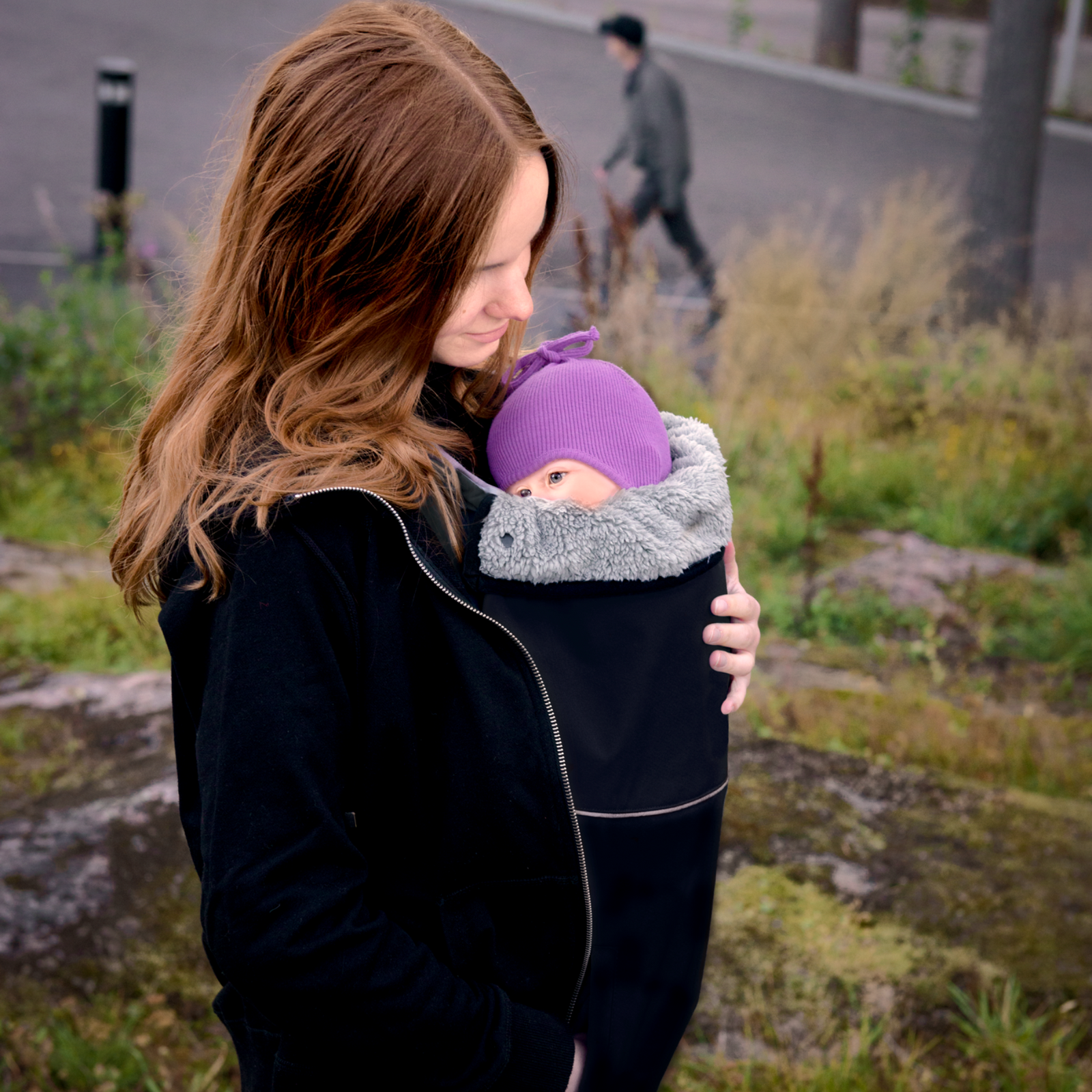

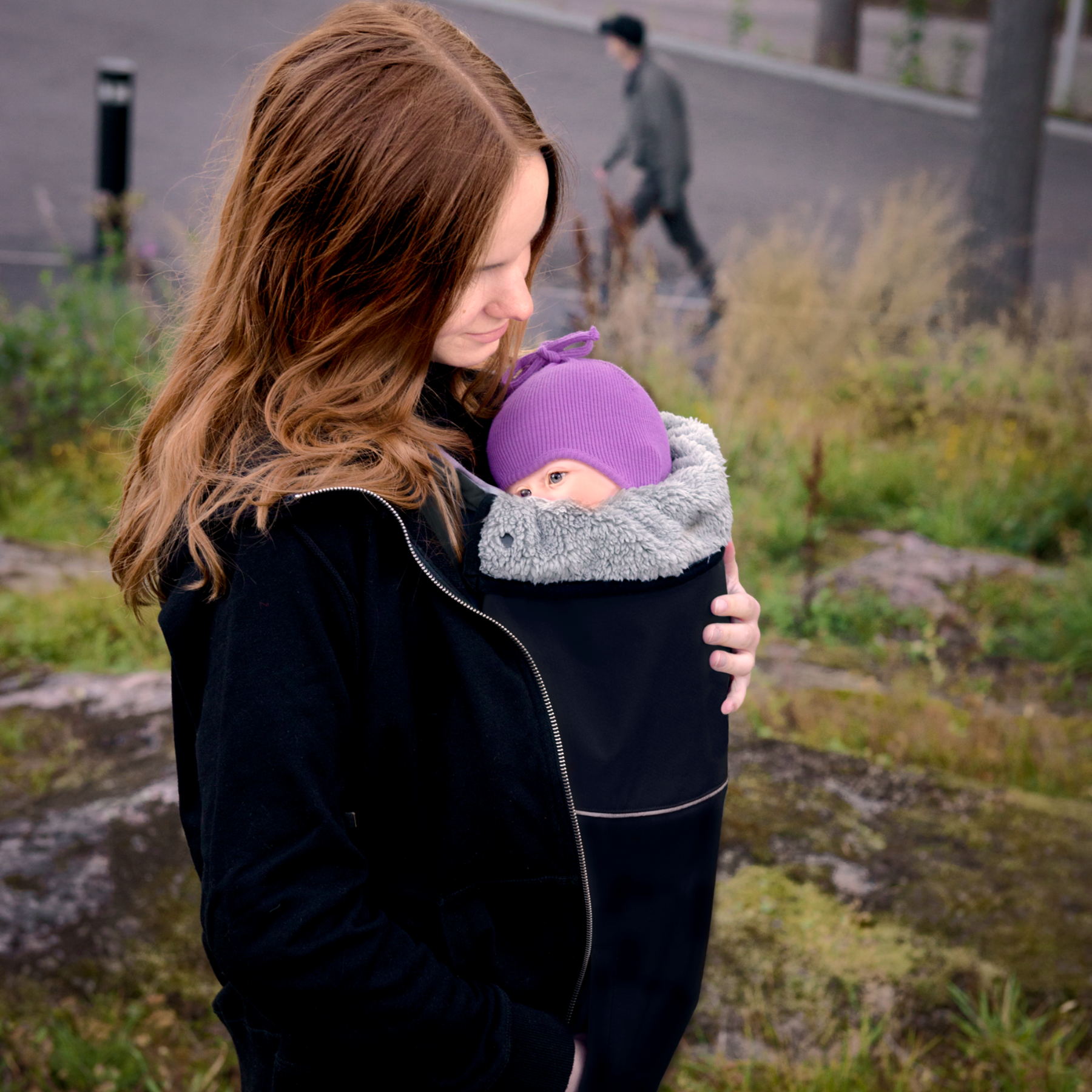
Yes, the baby wrap is also suitable for newborns. The baby should be carried upright and symmetrically in the wrap with their legs in a frog-leg position.


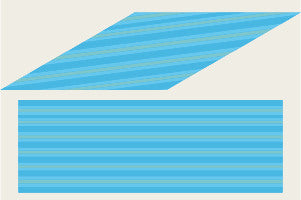
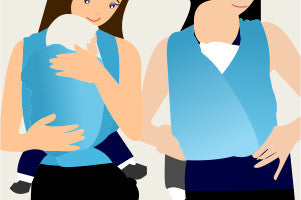
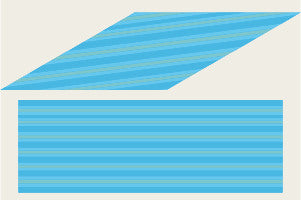
The two most common forms of baby slings are the parallelogram and the rectangle. A rectangular baby sling requires more fabric than a parallelogram, as the ends of the parallelogram taper narrowly and the knot is smaller than that of a rectangular sling.
Tip: A rectangular baby sling must be longer than a parallelogram-shaped baby sling.
Note: We do not offer rectangular baby slings!
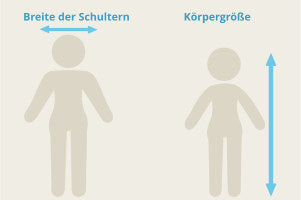
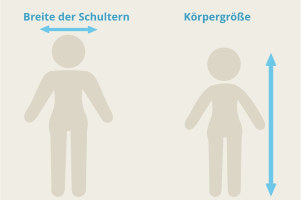
Body measurements play a significant role here - not just the clothing size, but also the width of the shoulders. A tall woman with broader shoulders automatically requires more fabric than a small woman with a very slender build.
Many size charts are offered online for this purpose, but unfortunately, they are not exact either.
Tip: Seek advice from experienced babywearing consultants.
?
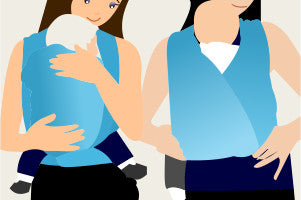
There are many different tying methods that require varying amounts of fabric.
For example, a rucksack carry requires less fabric than a wrap cross carry.
Tip: If you are unsure, you should seek the advice of a babywearing consultant before purchasing, or visit a consultant with your baby wrap after purchase.
For your child to have a healthy posture while being carried, a few things need to be observed. To check for yourself whether the baby wrap is tied correctly, we have created a checklist for you:
Is it the right height?
The right height is when you can easily kiss your little one on the head.
More precisely: your chin should not touch the baby's head even if you stumble.
How tight does the wrap need to be?
The baby wrap should be tied snugly so that the baby is sufficiently supported. For newborns, the head must be additionally supported, as children cannot hold their heads properly until 3 months of age. For an older baby, the wrap is snug enough if it provides good support, but at the same time allows the head to turn.
A simple test: Lean forward. If the baby stays in contact with you, the wrap is tight enough. If the baby falls away from you into the wrap, please tighten it again.
Is your darling sitting correctly?
Your baby should always be in the "spread-squat" position when being carried. Here, the position of the legs is important. The back of the knees should form a 90-degree angle (spread). The baby's knees should be higher than the bottom (squat). This position supports hip development.
Is your darling sitting comfortably?
The baby wrap should reach up to your darling's knee pits. Make sure that nothing chafes.
Do carrier and carried form a weight unit?
Your darling should not hang from you, but rather sway in the wrap in a squatting position rather than sitting. If this is the case, you form a weight unit.
Is your child dressed according to the temperature?
In winter, care must be taken to ensure that your child does not get too cold. Although the baby wrap provides additional warmth, sufficient clothing should still be worn. We recommend additional wool socks, leg warmers, and a warm hat!
In summer, neither you nor your child should sweat. At higher temperatures, a bodysuit under the baby wrap is often sufficient. A muslin cloth between you and your baby absorbs sweat. An airy tying method such as the kangaroo and backpack is helpful! At very high temperatures, especially around midday, you should consider whether you might want to forego carrying with a baby wrap.
It has already been mentioned that a baby wrap is more personal and comfortable for mothers of different cultures. We will show you how this can be applied to your everyday life using the following points:
Closeness to the child - Better bonding
When you use a baby wrap, you carry your child close to you. This allows you to react more intuitively to your child's signals. This enables you to better "read" your child's needs through certain movements or sounds.
Strengthening the immune system
It has been scientifically proven multiple times that using a baby wrap strengthens your child's immune system. This is mainly due to the direct contact with the mother or father and thus to the security that carrying brings.
Calming effect
Many mothers use a baby wrap to soothe their child. Some children quickly become calm in a hammock, others when driven around in a car, but the majority of children are best soothed by the closeness to their parents and the gentle movements when being carried.
Note: The calming effect also applies to digestive problems, as carrying in a baby wrap also promotes the baby's digestion.
Usable for newborns up to toddler age
As mentioned above, even a newborn can be carried in a baby wrap. In this case, care should be taken to use a wrapping or tying method that adequately supports the head.
Examples:
From birth
From 3 months
More pleasant travel
If you want to travel with your little one, the question naturally arises as to which mode of transport is best.
Flight - Stroller vs. Baby Wrap
A larger stroller must be checked as oversized baggage. Depending on the airline, this can mean enormous additional costs. But that's not all, as many parents have reported that their stroller was damaged during a flight. With a baby wrap, you don't have to worry about such things.
On the beach
With a baby wrap, you not only get additional protection from the sun's rays but also better mobility. On sand, a stroller can often be difficult to move.
Exploring a new city
Many places in the world have many small alleys, passages with stairs, or even no proper sidewalks. In such cities, using a stroller is an absolute torment. You either can't get anywhere or have to take long detours.
Discreet breastfeeding
A baby wrap can also serve as a privacy screen. With a baby wrap, you don't necessarily have to go to a ladies' room; you can also breastfeed discreetly in public.
Protection against overstimulation
With baby wraps, it is possible on the one hand to show your little one the world, and on the other hand, to simply protect your little one from overstimulation.
For parents and child to benefit from all the advantages of a baby wrap, the baby wrap must not only meet the parents' aesthetic demands, but also be safe.
Does it not matter which baby wrap I buy?
No, because especially nowadays, with countless suppliers offering various quality standards, one has to invest a little more time in finding the perfect baby wrap.
It can happen that some manufacturers offer baby wraps that are too thin or poorly woven. These baby wraps are not recommended, as their poor workmanship can pose a health risk.
If you observe the following 4 points, nothing stands in the way of a wonderful baby wrap experience!
1. Durable Baby Wrap Fabric - Weave and Material
Before buying, you should know what weave was used and what material the baby wrap is made from. The fabric of a baby wrap must be stretchy yet durable. Furthermore, not all fabrics are equally easy to tie.
Which weave is suitable for a baby wrap?
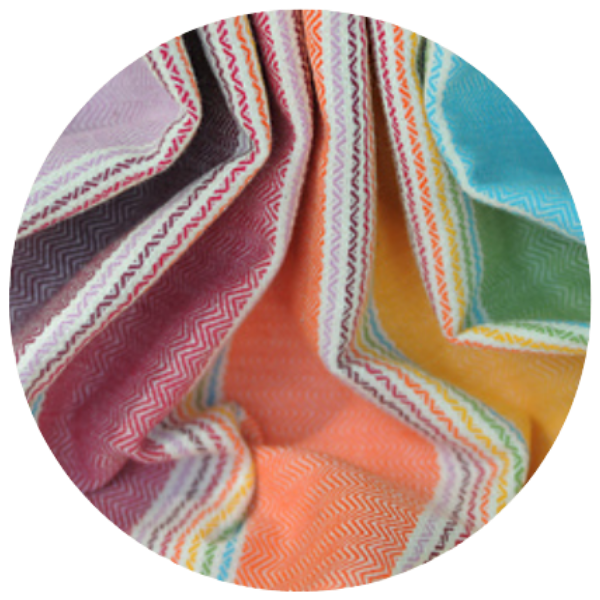
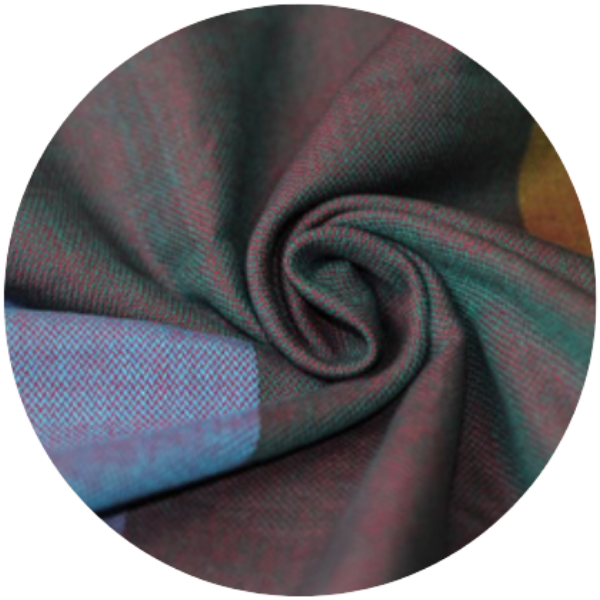
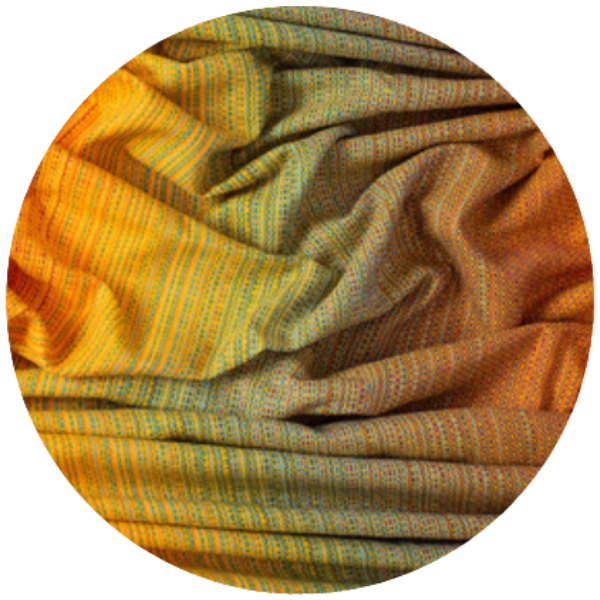
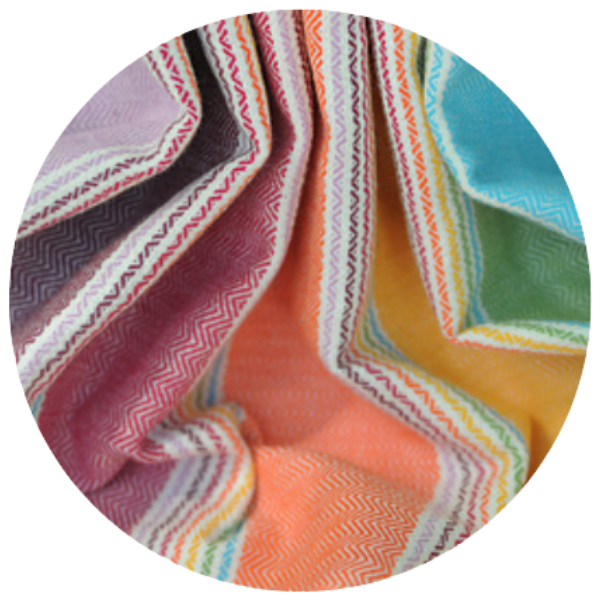
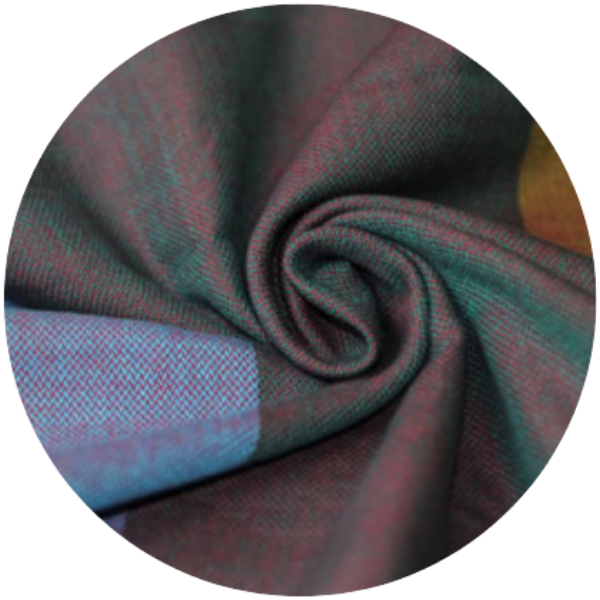
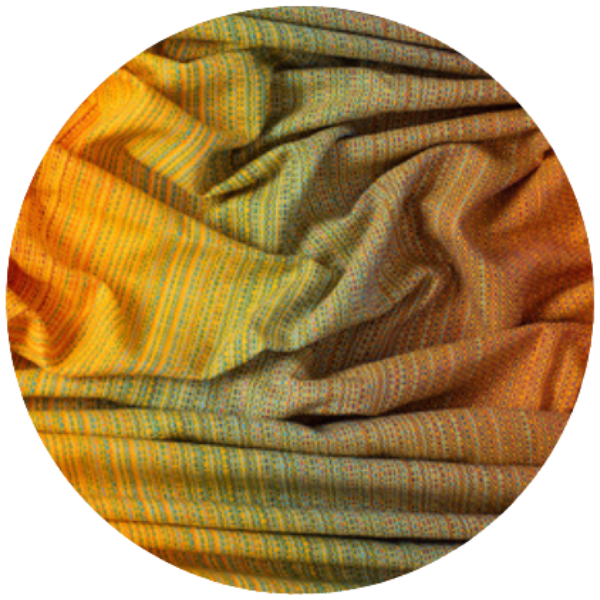
There are many suitable weaves for a durable baby wrap. The diagonal elasticity is important here. We offer baby wraps with the following weaves: cross twill, diamond twill, herringbone, honeycomb, and double weft.
These fabrics ensure that the wrap does not tear when carried and conforms well to the body.
Which material is the right one?
Cotton is most commonly used in the production of baby wraps. This is because cotton has a low allergy potential, is skin-friendly, easy to care for, durable, and stretchy.
2. Chemical-free Baby Wrap
As in all areas of life, when carrying our children, we try to protect them from dangerous influences. To ensure that you and your child can enjoy a baby wrap, you should make sure that the baby wrap is free of chemicals to avoid allergic reactions or other negative consequences.
Can I safely buy from well-known baby wrap manufacturers?
The major manufacturers known to us pay attention to this and only sell pollutant-free baby wraps.
3. Buying Used Baby Wraps
When buying a used baby wrap, you should look particularly closely and check for rips or holes. You should also ask the previous owner if the baby wrap has often been washed with fabric softener. If this is the case, the textile fibers may have been damaged, meaning the baby wrap offers less stability or its tying qualities have suffered.
4. The Perfect Design for You
Anyone who wants to use their baby wrap often naturally asks themselves: "Which design will suit me long-term?"
If you are unsure about the color choice, it makes sense to look in your wardrobe and choose a baby wrap that matches your clothing. If you tend to wear black or dark clothing anyway, then all imaginable colors will naturally fit.
Especially in large cities like Berlin, Hamburg, or Munich, you will see mothers on the street with the same baby wraps. If you want a unique piece, you can make it yourself or have a baby wrap sewn by a professional tailor.
If you want to sew a baby wrap yourself, you should use durable baby wrap fabric. You can find this in our category "Fabric by the Meter". Baby wrap fabric is not very cheap, this is because the weave with its diagonal elasticity is complex and special, and you are therefore acquiring a fabric with a long service life.
Note: If you have a baby wrap sewn, it is often advisable to buy the baby wrap fabric in advance to save a little money.
With good care, a baby sling can be used for many years, even for multiple children. You also have the option of reselling the sling with only a small loss of money.
Do not use fabric softeners
Fabric softeners attack the fibers of the fabric and change the binding properties of the baby sling. In addition, fabric softeners are harmful to the environment.
The wash cycle
Baby slings made of pure cotton can usually be washed at up to 60 degrees. However, this is not necessary. To ensure that you can enjoy your baby sling for a long time, we recommend gentle wash cycles at a maximum of 40 degrees and a low spin speed of a maximum of 900 revolutions.
There is also nothing against hand washing at 30 degrees with a mild detergent.
This way, your baby sling will be clean and retain all its positive properties.